When Did South Carolina Join the Union Agian When Did South Carolina Join the Union Again
| South Carolina | |
|---|---|
| Nickname(s): "Palmetto Republic" | |
| 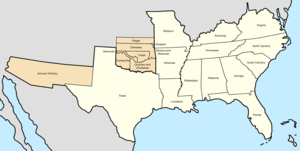 Map of the Confederate States | |
| Majuscule | Columbia |
| Largest metropolis | Charleston |
| Admitted to the Confederacy | April 3, 1861 (6th) |
| Population |
|
| Forces supplied |
|
| Major garrisons/armories | Fort Sumter, Charleston Harbor |
| Governor | Francis Pickens (1860–1862) Milledge Bonham Andrew Magrath |
| Senators | Robert Woodward Barnwell James Lawrence Orr |
| Representatives | Listing |
| Restored to the Marriage | July ix, 1868 |


Southward Carolina was the get-go state to secede from the Union in Dec 1860, and was i of the founding member states of the Confederacy in February 1861. The bombardment of the beleaguered U.S. garrison at Fort Sumter in Charleston Harbor on April 12, 1861 is generally recognized as the commencement military date of the war. The retaking of Charleston in Feb of 1865, and raising the flag (the same flag) again at Fort Sumter, was used for the Union the symbol of victory.
South Carolina provided around sixty,000 troops for the Confederate Army. Equally the war progressed, former slaves and free blacks of Southward Carolina joined U.South. Colored Troops regiments for the Union Regular army[ane] (most Blacks in Due south Carolina were enslaved at the war's outset). The state too provided uniforms, textiles, nutrient, and war material, too every bit trained soldiers and leaders from The Citadel and other military machine schools. In contrast to most other Amalgamated states, South Carolina had a well-developed rail network linking all of its major cities without a break of gauge. Relatively costless from Union occupation until the very stop of the war, South Carolina hosted a number of prisoner of war camps. S Carolina also was the merely Confederate state not to harbor pockets of anti-secessionist sentiment stiff enough to transport large numbers of white men to fight for the Marriage, every bit every other country in the Confederacy did.[2]
Among the leading generals from the Palmetto Country were Wade Hampton III, one of the Confederacy'south foremost cavalry commanders, Maxcy Gregg, killed in action at Fredericksburg, Joseph B. Kershaw, whose Due south Carolina infantry brigade saw some of the hardest fighting of the Ground forces of Northern Virginia and James Longstreet, the senior lieutenant general in the regular army, and Stephen D. Lee, the youngest lieutenant full general.
Background [edit]
The white population of the state had strongly supported the institution of slavery since the 18th century. Political leaders such as Democrats John Calhoun and Preston Brooks had inflamed regional and national passions in support of the institution, and many pro-slavery voices had cried for secession.
For decades, South Carolinian political leaders had promoted regional passions with threats of nullification and secession in the name of southern states' rights and protection of the interests of the slave power.
Alfred P. Aldrich, a South Carolinian politician from Barnwell, stated that declaring secession would exist necessary if a Republican candidate were to win the 1860 U.S. presidential election, stating that it was the only way for the land to preserve slavery and diminish the influence of the anti-slavery Republican Party, which, were its goals of abolitionism realized, would result in the "destruction of the South":
If the Republican political party with its platform of principles, the chief characteristic of which is the abolition of slavery and, therefore, the devastation of the South, carries the country at the side by side Presidential ballot, shall we remain in the Matrimony, or course a separate Confederacy? This is the slap-up, grave issue. It is not who shall be President, it is not which party shall rule – it is a question of political and social existence.
—Alfred P. Aldrich, [three]
In a January 1860 speech, Southward Carolinian congressman Laurence Massillon Keitt, summed upwards this view in an oratory condemning the "anti-slavery political party" (i.eastward. the Republican Party) for its views confronting slavery. He claimed that slavery was non morally wrong, but rather, justified:
The anti-slavery party contends that slavery is incorrect in itself, and the Authorities is a consolidated national commonwealth. Nosotros of the South argue that slavery is right...
Later that yr, in December, Keitt would state that South Carolina'southward declaring of secession was the direct result of slavery:
Our people have come to this on the question of slavery.
Secession [edit]
On Nov 9, 1860 the Due south Carolina General Assembly passed a "Resolution to Call the Election of Abraham Lincoln every bit U.South. President a Hostile Act" and stated its intention to declare secession from the The states.[6]
In December 1860, amid the secession crisis, old S Carolinian congressman John McQueen wrote to a group of borough leaders in Richmond, Virginia, regarding the reasons equally to why South Carolina was contemplating secession from the United States. In the letter, McQueen claimed that U.Southward. president-elect Abraham Lincoln supported equality and civil rights for African Americans also every bit the abolition of slavery, and thus S Carolina, being opposed to such measures, was compelled to secede:
I have never doubted what Virginia would exercise when the alternatives nowadays themselves to her intelligent and gallant people, to choose between an association with her sisters and the rule of a people, who accept chosen their leader upon the single idea that the African is equal to the Anglo-Saxon, and with the purpose of placing our slaves on equality with ourselves and our friends of every condition! and if we of South Carolina have aided in your deliverance from tyranny and degradation, equally yous suppose, it will only the more assure us that nosotros have performed our duty to ourselves and our sisters in taking the starting time decided step to preserve an inheritance left u.s.a. by an ancestry whose spirit would prevent its being tarnished by assassins. We, of South Carolina, hope soon to peachy yous in a Southern Confederacy, where white men shall rule our destinies, and from which we may transmit to our posterity the rights, privileges and honor left u.s. past our ancestors.
—John McQueen, Correspondence to T.T. Cropper and J.R. Crenshaw, (December 24, 1860)[7] [viii]
South Carolinian Presbyterian minister James Henley Thornwell too espoused a similar view to McQueen'south, stating that slavery was justified nether the Christian religion, and thus, those who viewed slavery as being immoral were opposed to Christianity:
The parties in the disharmonize are non only abolitionists and slaveholders. They are atheists, socialists, communists, ruby republicans, Jacobins on the one side, and friends of lodge and regulated freedom on the other. In ane give-and-take, the world is the battleground – Christianity and Atheism the combatants; and the progress of humanity at pale.
And again, the Southern Presbyterian of S.C. declared that:
Anti-slavery is essentially infidel. It wars upon the Bible, on the Church of Christ, on the truth of God, on the souls of men.
—Southern Presbyterian of S.C., [8]
On November 10, 1860 the South.C. Full general Assembly called for a "Convention of the People of Southward Carolina" to consider secession. Delegates were to be elected on December 6.[9] The secession convention convened in Columbia on Dec 17 and voted unanimously, 169-0, to declare secession from the United States. The convention and then adjourned to Charleston to draft an ordinance of secession. When the ordinance was adopted on December 20, 1860, South Carolina became the first slave state in the south to declare that it had seceded from the Us.[10] [xi] James Buchanan, the United States president, declared the ordinance illegal simply did non act to end information technology.
A committee of the convention also drafted a Declaration of the Immediate Causes Which Induce and Justify the Secession of Due south Carolina which was adopted on Dec 24.[12] The secession declaration stated the primary reasoning behind South Carolina's declaring of secession from the U.S., which was described equally:
...increasing hostility on the part of the not-slaveholding States to the Establishment of Slavery ...
The declaration also claims that secession was declared every bit a result of the refusal of gratis states to enforce the Fugitive Slave Acts. Although the declaration does debate that secession is justified on the grounds of U.Southward. "encroachments upon the reserved rights of the States," the grievances that the annunciation goes on to list are mainly concerned with the property of rights of slave holders. Broadly speaking, the proclamation argues that the U.S. Constitution was framed to establish each State "every bit an equal" in the Union, with "separate command over its ain institutions", such as "the right of belongings in slaves."
We affirm that these ends for which this Regime was instituted accept been defeated, and the Government itself has been made destructive of them by the activeness of the not-slaveholding States. Those States have assumed the correct of deciding upon the propriety of our domestic institutions; and accept denied the rights of property established in fifteen of the States and recognized by the Constitution; they have denounced equally sinful the establishment of Slavery; they have permitted the open establishment among them of societies, whose avowed object is to disturb the peace and to eloign the property of the citizens of other States. They accept encouraged and assisted thousands of our slaves to exit their homes; and those who remain, take been incited by emissaries, books and pictures to servile coup.
A repeated concern is runaway slaves. The announcement argues that parts of the U.Due south. Constitution were specifically written to ensure the return of slaves who had escaped to other states, and quotes the fourth Article: "No person held to service or labor in one State, nether the laws thereof, escaping into another, shall, in consequence of any law or regulation therein, be discharged from such service or labor, but shall be delivered up, on claim of the party to whom such service or labor may exist due." The declaration goes on to country that this stipulation of the Constitution was then of import to the original signers, "that without it that meaty [the Constitution] would non have been made." Laws from the "General Government" upheld this stipulation "for many years," the declaration says, merely "an increasing hostility on the part of the not-slaveholding States to the Institution of Slavery has led to a condone of their obligations." Because the constitutional understanding had been "deliberately broken and disregarded by the non-slaveholding States," the consequence was that "S Carolina is released from her obligation" to be part of the Union.
A farther business organization was Lincoln's recent ballot to the presidency, whom they claimed desired to see slavery on "the course of ultimate extinction":
A geographical line has been drawn across the Spousal relationship, and all the states due north of that line have united in the election of a man to the loftier office of President of the U.s.a. whose opinions and purposes are hostile to slavery. He is to be entrusted with the administration of the Common Government, because he has declared that that "Government cannot suffer permanently one-half slave, half free," and that the public listen must rest in the belief that Slavery is in the form of ultimate extinction.[13]
The S Carolinian secession declaration of December 1860 also channeled some elements from the U.South. Declaration of Independence from July 1776. However, the South Carolinian version omitted the phrases that "all men are created equal", "that they are endowed by their Creator with certain unalienable Rights", and mentions of the "consent of the governed". Professor and historian Harry V. Jaffa noted these omissions equally significant in his 2000 volume, A New Birth of Liberty: Abraham Lincoln and the Coming of the Ceremonious State of war:
South Carolina cites, loosely, merely with substantial accuracy, some of the language of the original Declaration. That Announcement does say that it is the correct of the people to abolish any form of regime that becomes subversive of the ends for which it was established. Just South Carolina does non repeat the preceding language in the before certificate: "Nosotros agree these truths to be self-evident, that all men are created equal"...
—Harry Jaffa, A New Nativity of Freedom: Abraham Lincoln and the Coming of the Civil War, (2000)[fourteen]
Jaffa states that Due south Carolina omitted references to homo equality and consent of the governed in its secession declaration, equally due to their racist and pro-slavery views, secessionist S Carolinians did non believe in those ideals:
[K]overnments are legitimate only insofar as their "just powers" are derived "from the consent of the governed." All of the foregoing is omitted from Southward Carolina'south declaration, for obvious reasons. In no sense could it have been said that the slaves in Southward Carolina were governed by powers derived from their consent. Nor could it be said that South Carolina was separating itself from the government of the Matrimony because that government had get destructive of the ends for which it was established. Southward Carolina in 1860 had an entirely different idea of what the ends of regime ought to be from that of 1776 or 1787. That difference can be summed upwards in the divergence betwixt holding slavery to be an evil, if perhaps a necessary evil, and property it to exist a positive good.
—Harry Jaffa, A New Birth of Liberty: Abraham Lincoln and the Coming of the Ceremonious War, (2000), emphasis added.[14]
On Dec 25, the twenty-four hour period post-obit S Carolina's declaration of secession, a South Carolinian convention delivered an "Accost to the Slaveholding States":
We adopt, however, our system of industry, by which labor and upper-case letter are identified in involvement, and uppercase, therefore, protects labor–past which our population doubles every 20 years–by which starvation is unknown, and abundance crowns the land–by which order is preserved by unpaid constabulary, and the most fertile regions of the globe, where the white human being cannot labor, are brought into usefulness past the labor of the African, and the whole globe is blest past our own productions. ... We ask yous to bring together us, in forming a Confederacy of Slaveholding States.
—Convention of S Carolina, Address of the people of Southward Carolina to the people of the Slaveholding States, (December 25, 1860)[fifteen]
"Slavery, not states' rights, birthed the Civil State of war,"[sixteen] argues sociologist James W. Loewen. Writing of South Carolina's Declaration of Secession, Loewen writes that
South Carolina was further upset that New York no longer immune "slavery transit." In the past, if Charleston gentry wanted to spend August in the Hamptons, they could bring their cook along. No longer — and South Carolina's delegates were outraged. In add-on, they objected that New England states let black men vote and tolerated abolitionist societies. According to South Carolina, states should not have the right to allow their citizens assemble and speak freely when what they said threatened slavery. Other seceding states echoed South Carolina. "Our position is thoroughly identified with the institution of slavery — the greatest cloth interest of the globe," proclaimed Mississippi in its own secession declaration, passed Jan. 9, 1861. "Its labor supplies the production which constitutes by far the largest and nigh of import portions of the commerce of the globe. . . . A blow at slavery is a blow at commerce and civilization."
The land adopted the palmetto flag as its banner, a slightly modified version of which is used as its current state flag.[17] South Carolina after secession was frequently called the "Palmetto Republic".[18]
After Due south Carolina declared its secession, former congressman James L. Petigru famously remarked, "Due south Carolina is also small for a democracy and besides big for an insane aviary."[19] Soon afterward, Southward Carolina began preparing for a presumed U.S. armed services response while working to convince other southern states to secede too and join in a confederacy of southern states.
On Feb iv, 1861, in Montgomery, Alabama, a convention consisting of delegates from South Carolina, Florida, Alabama, Mississippi, Georgia, and Louisiana met to form a new constitution and government modeled on that of the United states of america.[xx] On Feb 8, 1861, South Carolina officially joined the Confederacy. According to ane Southward Carolinian paper editor:
The South is now in the formation of a Slave Commonwealth...
—L.W. Spratt, The Philosophy of Secession: A Southern View, (February thirteen, 1861).[21]
South Carolina's declaring of secession was supported by the land's religious figures, who claimed that it was consistent with the tenets of their religion:
The triumphs of Christianity rest this very hour upon slavery; and slavery depends on the triumphs of the South... This war is the servant of slavery.
—John T. Wightman, The Glory of God, the Defence force of the Southward, (1861).[22]
American Ceremonious State of war [edit]

1862 U.Due south. Coast Survey map of the Declension of South Carolina from Charleston to Hilton Head
Fort Sumter [edit]

Fort Sumter, 1861, flying the Confederate flag afterward the fort'south capture from the U.S. by the Confederacy.
Six days afterwards secession, on the day after Christmas, Major Robert Anderson, commander of the U.S. troops in Charleston, withdrew his men to the island fortress of Fort Sumter in Charleston Harbor. South Carolina militia swarmed over the abandoned mainland batteries and trained their guns on the island. Sumter was the fundamental position for preventing a naval assault upon Charleston, so secessionists were determined not to allow U.S. forces to remain there indefinitely. More importantly, South Carolina's claim of independence would look empty if U.S. forces controlled its largest harbor. On Jan 9, 1861, the U.S. ship Star of the West approached to resupply the fort. Cadets from The Citadel, The Military machine College of Due south Carolina fired upon the Star of the West, striking the ship three times and causing it to retreat back to New York.
Mississippi declared its secession several weeks after S Carolina, and five other states of the lower South shortly followed. Both the outgoing Buchanan administration and President-elect Lincoln had denied that any state had a right to secede. Upper Southern slave states such equally Virginia and North Carolina, which had initially voted against secession, chosen a peace conference, to petty effect. Meanwhile, Virginian orator Roger Pryor barreled into Charleston and proclaimed that the only way to get his country to join the Confederacy was for South Carolina to instigate state of war with the United states. The obvious place to start was correct in the midst of Charleston Harbor.
On April 10, the Mercury reprinted stories from New York papers that told of a naval trek that had been sent southward toward Charleston. Lincoln advised the governor of South Carolina that the ships were sent to resupply the fort, not to reinforce it. The Carolinians could no longer look if they hoped to take the fort before the U.S. Navy arrived. About 6,000 men were stationed effectually the rim of the harbor, gear up to accept on the 60 men in Fort Sumter. At 4:30 a.k. on April 12, later on two days of intense negotiations, and with Union ships approaching the harbor, the firing began. Students from The Citadel were amidst those firing the first shots of the war, though Edmund Ruffin is usually credited with firing the first shot. Thirty-four hours later, Anderson's men raised the white flag and were allowed to leave the fort with colors flying and drums beating, saluting the U.S. flag with a fifty-gun salute before taking it downward. During this salute, one of the guns exploded, killing a young soldier—the only prey of the bombardment and the get-go casualty of the war.
In December 1861, Due south Carolina received $100,000 from Georgia afterwards a disastrous burn in Charleston.
Fort Wagner [edit]
Fort Wagner was the scene of two battles. The Offset Battle of Fort Wagner, occurred on July 11, 1863. Merely 12 Confederate soldiers were killed, equally opposed to the Union'south 339 losses.[23]

The Second Battle of Fort Wagner, a week later, is better known. This was the Union attack on July 18, 1863, led by the 54th Massachusetts Volunteer Infantry, one of the first major American military units made upwards of black soldiers. Colonel Robert Gould Shaw led the 54th Massachusetts on foot while they charged, and was killed in the assault.[23]
Although a tactical defeat, the publicity of the battle of Fort Wagner led to farther action for blackness troops in the Civil War, and it spurred additional recruitment that gave the Union Army a further numerical advantage in troops over the South.[23]
The Union besieged the fort after the unsuccessful attack. By August 25, Marriage entrenchments were close plenty to effort an assail on the Avant-garde Rifle Pits, 240 yards in front of the Battery, but this endeavour was defeated. A second attempt, by the 24th Mass. Inf., on August 26 was successful. After enduring almost threescore days of heavy shelling, the Confederates abased information technology on the night of September 6–vii, 1863. withdrawing all operable cannons and the garrison.[23] [24]
The war ends [edit]
The Confederates were at a disadvantage in men, weaponry, and supplies. Union ships sailed southward and blocked off ane port afterwards another. As early as November, Marriage troops occupied the Sea Islands in the Beaufort area, establishing an important base for the men and ships who would obstruct the ports at Charleston and Savannah. Many plantation owners had already gone off with the Confederate Army; those all the same at home and their families fled. In a type of reparation long discussed in abolitionist literature, the abandoned plantations were confiscated past the Marriage Army and then given to the African Americans who had washed the work of them. The Body of water Islands became the laboratory for Union plans to educate the African Americans for their eventual role equally total American citizens.
Despite South Carolina's important role in the beginning of the state of war, and a long unsuccessful attempt to have Charleston from 1863 onward, few military engagements occurred within the state's borders until 1865, when Sherman'south Army, having already completed its March to the Sea in Savannah, marched to Columbia and leveled most of the town, also as a number of towns forth the way and later. South Carolina lost 12,922 men to the war, 23% of its male white population of fighting age, and the highest pct of any state in the nation. Sherman'south 1865 march through the Carolinas resulted in the burning of Columbia and numerous other towns. The devastation his troops wrought upon South Carolina was even worse than in Georgia, because many of his men bore a detail grudge confronting the country and its citizens, whom they blamed for starting the state of war. One of Sherman's men declared, "Here is where treason began and, by God, hither is where it shall cease!"[25] Deprived of the complimentary labor of the formerly enslaved, poverty would mark the state for generations to come.
In January 1865, the Charleston Courier newspaper condemned suggestions that the Confederacy abandon slavery were it to assist in gaining independence, stating that such suggestions were "folly":
To talk of maintaining our independence while nosotros cancel slavery is only to talk folly.
— Courier, (Jan 24, 1865)[26]
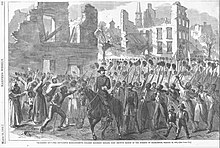
On Feb 21, 1865, with the Confederate forces finally evacuated from Charleston, the blackness 54th Massachusetts Regiment marched through the urban center. At a ceremony at which the U.Due south. flag was one time once more raised over Fort Sumter, erstwhile fort commander Robert Anderson was joined on the platform by two men: African American Wedlock hero Robert Smalls and the son of Denmark Vesey.
Battles in Southward Carolina [edit]
- Boxing of Fort Sumter
- Battle of Port Royal
- Boxing of Secessionville
- Battle of Simmon's Barefaced
- Beginning Boxing of Charleston Harbor
- Second Battle of Charleston Harbor
- Second Battle of Fort Sumter
- Kickoff Boxing of Fort Wagner
- Battle of Grimball'southward Landing
- Second Battle of Fort Wagner (Morris Island)
- Battle of Honey Loma
- Battle of Tulifinny
- Boxing of Rivers' Bridge
- Battle of Anderson County
- Boxing of Brattonsville
- Battle of Broxton's Bridge
- Battle of Cheraw
- Battle of Chance'due south Hotel (The Columns)
- Boxing of Aiken
Restoration to Union [edit]
Post-obit the stop of the Civil War, Due south Carolina was part of the Second Armed services District.
Afterward meeting the requirements of Reconstruction, including ratifying amendments to the Usa Constitution to abolish slavery and grant citizenship to former slaves, Due south Carolina's representatives were readmitted to Congress. The state was fully restored to the U.s. on July 9, 1868.
As office of the Compromise of 1877, in which Southern Democrats would acknowledge Republican Rutherford B. Hayes as president, Republicans would meet certain demands. One affecting South Carolina was the removal of all U.S. military forces from the erstwhile Confederate states.[27] At the fourth dimension, U.S. troops remained in only Louisiana, South Carolina, and Florida, but the Compromise completed their withdrawal from the region.
Encounter likewise [edit]
- Listing of Southward Carolina Amalgamated Civil War units
- List of S Carolina Wedlock Civil War units
References [edit]
- ^ Snyder, Laurie. "Blackness History Calendar month: New Details Uncovered Regarding the Formerly Enslaved Blackness Men Who Enlisted with the 47th Pennsylvania Volunteer Infantry," in "47th Pennsylvania Volunteers: One Civil War Regiment's Story," retrieved online February 27, 2021.
- ^ Weiser, Kathy. (2017). Civil State of war Battles of South Carolina. Legends of America. Retrieved February v, 2021.
- ^ Channing, Steven. Crisis of Fear. pp. 141–142. Retrieved September vi, 2015.
- ^ Keitt, Lawrence Thou. (January 25, 1860). Congressman from S Carolina, in a oral communication to the Firm. Taken from a photocopy of the Congressional Earth, supplied by Steve Miller.
The anti-slavery political party contends that slavery is wrong in itself, and the Government is a consolidated national republic. We of the South contend that slavery is correct, and that this is a confederate Commonwealth of sovereign States.
- ^ "The Charleston Courier". Charleston, Due south Carolina. December 22, 1860. Retrieved September half-dozen, 2015.
- ^ "Resolution to Telephone call the Election of Abraham Lincoln as U.Due south. President a Hostile Act and to Communicate to Other Southern States South Carolina's Desire to Secede from the Union." 9 November 1860. Resolutions of the General Assembly, 1779–1879. S165018. South Carolina Section of Athenaeum and History, Columbia, S Carolina.
- ^ McQueen, John (December 24, 1860). "Correspondence to T. T. Cropper and J. R. Crenshaw". Washington, D.C. Archived from the original on March 25, 2015. Retrieved March 25, 2015.
{{cite spider web}}: CS1 maint: unfit URL (link) - ^ a b c Rhea, Gordon (January 25, 2011). "Why Not-Slaveholding Southerners Fought". Civil War Trust. Civil War Trust. Archived from the original on March 21, 2011. Retrieved March 21, 2011.
{{cite web}}: CS1 maint: unfit URL (link) - ^ Cauthen, Charles Edward; Power, J. Tracy. Due south Carolina goes to war, 1860–1865. Columbia, SC: University of South Carolina Printing, 2005. Originally published: Chapel Hill, NC: University of North Carolina Press, 1950. ISBN 978-one-57003-560-9. p. 60.
- ^ "Results from the 1860 Census". 1860 United States Census. 1860. Archived from the original on June 4, 2004. Retrieved June 4, 2004.
{{cite web}}: CS1 maint: unfit URL (link) - ^ Hall, Andy (December 22, 2013). "Not Surprising, Function Deux". Dead Confederates: A Ceremonious War Era Blog.
U.s. with the largest proportions of slaves and slave-holders seceded primeval.
- ^ a b "'Declaration of the Immediate Causes Which Induce and Justify the Secession of South Carolina from the Federal Union,' 24 Dec 1860". Education American History in South Carolina Projection. 2009. Retrieved November xviii, 2012.
- ^ a b "Declaration of the Immediate Causes Which Induce and Justify the Secession of South Carolina from the Federal Union".
- ^ a b Jaffa, Harry V. (2000). A New Birth of Freedom: Abraham Lincoln and the Coming of the Civil State of war . Rowman & Littlefield Publishers. p. 231. ISBN9780847699520.
- ^ State of South Carolina (December 25, 1860). "Accost of the people of Due south Carolina to the people of the Slaveholding States of the United States". Retrieved March 27, 2015.
- ^ a b Loewen, James (2011). "Five Myths Virtually Why the South Seceded". Washington Mail service.
- ^ Edgar, Walter. South Carolina: A History, Columbia, SC: University of South Carolina Press:1998. ISBN 978-1-57003-255-four. p. 619
- ^ Cauthen, Charles Edward; Ability, J. Tracy. Due south Carolina goes to war, 1860–1865. Columbia, SC: University of South Carolina Press, 2005. Originally published: Chapel Hill, NC: University of Northward Carolina Press, 1950. ISBN 978-ane-57003-560-ix. p. 79.
- ^ Burger, Ken (February 13, 2010). "As well large to be an asylum". The Mail service and Courier. Charleston, South Carolina: Evening Post Publishing Co. Retrieved April 22, 2010. Paragraph 4
- ^ Lee, Jr., Charles Robert. The Amalgamated Constitutions. Chapel Hill, NC: The University of North Carolina Press, 1963, lx.
- ^ Spratt, L.W. (February 13, 1861). "THE PHILOSOPHY OF SECESSION: A SOUTHERN VIEW". South Carolina. Retrieved September 13, 2015.
Presented in a Letter addressed to the Hon. Mr. Perkins of Louisiana, in criticism on the Provisional Constitution adopted by the Southern Congress at Montgomery, Alabama, BY THE HON. L. W. SPRATT, Editor of the Charleston Mercury, 13th Feb, 1861.
- ^ Wightman, John T. (1861). "The Glory of God, the Defence force of the South". Yorkville, South Carolina. Retrieved September 8, 2015.
- ^ a b c d The 54th and Fort Wagner Archived September 30, 2007, at the Wayback Auto
- ^ Wittenburg, Eric J., The Battle of Tom's Brook Northward & Due south - The Official Mag of the Civil War Society, Volume x, Number 1, Page 30.
- ^ McPherson, James M. This Mighty Scourge: Perspectives on the Civil War. Oxford Academy Press, 2009
- ^ "Courier". Charleston. Jan 24, 1865. Retrieved September 8, 2015.
- ^ Woodward, C. Vann (1966). Reunion and Reaction: The Compromise of 1877 and the Stop of Reconstruction. Boston: Picayune, Chocolate-brown and Visitor. pp. 169–171.
Further reading [edit]
- Burger, Ken (February xiii, 2010). "Too large to be an asylum". The Post and Courier. Charleston, Southward Carolina: Evening Post Publishing Co. Retrieved April 22, 2010. .
- Cauthen, Charles Edward; Ability, J. Tracy. Due south Carolina goes to war, 1860–1865. Columbia, SC: Academy of South Carolina Press, 2005. Originally published: Chapel Loma, NC: University of N Carolina Printing, 1950. ISBN 978-1-57003-560-nine.
- Edgar, Walter. S Carolina: A History, Columbia, SC: Academy of South Carolina Press:1998. ISBN 978-1-57003-255-4.
- Rogers Jr. George C. and C. James Taylor. A South Carolina Chronology, 1497-1992 2nd Ed. (1994)
- Wallace, David Duncan. South Carolina: A Short History, 1520-1948 (1951) standard scholarly history
- WPA. S Carolina: A Guide to the Palmetto Country (1941)
- Wright, Louis B. South Carolina: A Bicentennial History' (1976)
External links [edit]
- Declaration of the Firsthand Causes Which Induce and Justify the Secession of Southward Carolina from the Federal Union
- National Park Service map of Civil War sites in S Carolina
Coordinates: 34°Due north 81°W / 34°N 81°W / 34; -81
Source: https://en.wikipedia.org/wiki/South_Carolina_in_the_American_Civil_War
0 Response to "When Did South Carolina Join the Union Agian When Did South Carolina Join the Union Again"
Post a Comment